
Just Curious
what I'd tell my first grade self

Hi, readers of the intangibles! I’m essayist Allison Kirkland, and I’m so glad you’re here at the start of a new year. Stay awhile!
What happened to your hands?
Are you a kid or a grown up?
Can you write?
Are you an alien?
Did you fingers get bitten off?
Are your fingers going to grow back?
How do you write?
I’ve gotten these questions for as long as I’ve known language, some from kids and some from adults. In classrooms and summer camps, at McDonald’s playgrounds and birthday parties, at the mall and out to eat. These questions feel like a pebble in my shoe that feels too small to take the time to remove, but still scrapes at my foot.
As a child I was taught that it was my responsibility to answer these questions about my body, to anyone who asked. The first suggestion that it was my obligation to educate the world happened when I was at an appointment with a doctor, just before I entered first grade. My mom and I were there so I could try out some accessible tools that might help me use writing utensils with more ease.
The doctor peered down at me with a kind smile on his face as I was looking at the tools.
“Allison,” he said, “Some other kids that you meet in school might be curious about your hands. If they ask what happened, it’s because they are afraid it might happen to them. You have a very important job: you can make them feel better by letting them know that you were born that way.”
Kids had already been asking about my hands, but this was the first time someone was telling me why it was happening (though I’m not sure he was correct), and what I should do about it. I began to see it as my duty to answer every question. In fact, I saw it as the price I paid for looking different in a world that’s more comfortable with sameness. It came with the territory, just something I had to deal with, like the difficulty of finding cute clothes in my size or getting a car adapted so I could use it. For a long time I didn’t even question that things could be different.
I even thought that maybe if I answered these questions, as nicely and as entertainingly as possible, I might be seen as a little bit more human, that maybe the differences of my body could slide to the background, replaced by something that other people could understand. My humor. My intelligence. My ability to make someone a little more comfortable in my presence.
As I got older, and became more aware that there were other kids like me, and that they probably got the same tough questions, I figured out how I could make these difficult moments into something purposeful. What could I make out of these invasive questions? Well, I could use them to teach, to make the world an easier place for people like me who look different.
Sure, these questions made me feel isolated, like I was on display, but at least if I explained myself, someone might learn something, might understand me better, and afford me more humanity in the world. The world would be educated, aware. People younger than me would grow up in an easier world, maybe a world where they didn’t get these same questions.
And it’s better than the alternative, right? The times I’ve seen parents shush their kids, or move them out of the way before I can catch them staring. Those kinds of actions teach kids that maybe bodies outside the norm aren’t even worth talking about, or maybe taboo. It’s better to encourage these conversations, to bring them out in the open, to normalize.
But I’ve been thinking lately about how that makes me feel, as the person who does the educating. The years of answering all the questions, no matter what I was doing: waiting at the waterpark, at Disneyworld, at the nail salon or the office. The years of being expected to explain my body in a way that others could understand, in a way that might make them see me as a little more human. Does it make me feel like a person?
***
These days I don’t feel a lot of obligation to satiate the curiosity of other adults, but I do feel some obligation to accommodate children. After all — as I’ve heard so many times — children are just curious. Unlike adults, they are in the process of learning about the world. Why wouldn’t someone like me, if given the chance, want to educate them, be a part of that discovery? Children don’t know any better, people say. We have to teach them how to be in the world. So usually, wherever I am and whatever I am doing, I will try to answer a child who asks these questions.
Then this month I saw an Instagram post written by appearance activist and writer Carly Findlay, who lives with a skin condition that makes her face red and flaky. Carly often gets variations on these same questions: why does your face look like that? Does it hurt? Her Instagram post said:
“Today I didn’t want to be asked about my face or stared at. So I asked the two people doing it (two people in two different settings) not to. Because it’s exhausting. I just want to get through a Pilates class without needing to satisfy a stranger’s curiosity. And I want to eat dinner without being stared at by a child, despite me smiling at them and saying hello a few times.”
The boundaries! The poise! It felt almost sacrilegious. But also I found myself moving through the world differently after I read it. Was I allowed to do that too? I don’t think I’ve ever asked someone to stop staring at me. But Carly’s generous words gave me radical permission to draw my own boundaries.
What if I just …. didn’t want to answer the question? What if I wanted to go about my day? What if I didn’t want to be stared at? Why is the onus always on me to be the educator, the person being looked at? Do I have to be smart enough, clever enough, kind enough, accommodating enough? Do I have to perform in order to have my full humanity?
A few days later I read an interview with writer Rebekah Taussig. She and Carly are two writers whose work I’ve been following for the last few years.
Rebekah talked about experiencing childhood in a wheelchair, how her mother, in an effort to help when she was a new student, got up in front of the class at the beginning of the year to explain Rebekah’s body to the room, hoping to get out ahead of the questions Rebekah might be asked to answer. Rebekah said:
“[My mother supposed that] if you answer all the questions in one fell swoop, the questions will all be answered, and you will be made human to the onlookers. I’m not sure it works like this, though. And it’s taken me much longer to realize that how a person responds to questions like this communicates just as much as what you answer.
Taking time out of a school day to explain one student to the rest of the class may satiate some questions about that body, but it is also showing the room that this body warrants explanation. Sometimes teaching doesn’t require answering a question or giving a lesson. Sometimes teaching is embodying a boundary.”
It felt right to read these two passages in January, the beginning of a new year. What if part of my own education is to draw my boundaries? What if that is a lesson to the world in and of itself?
I will never stop educating on my own terms, through my writing and speaking. Many times, while educating, I’ll even learn something about myself that I didn’t know. I use this space as a way to educate, which means that sometimes I even get paid for it. And as I’ve connected with more disability and appearance activists on social media over the years, I’ve realized that it’s not just me doing the educating. There are many doing the work.
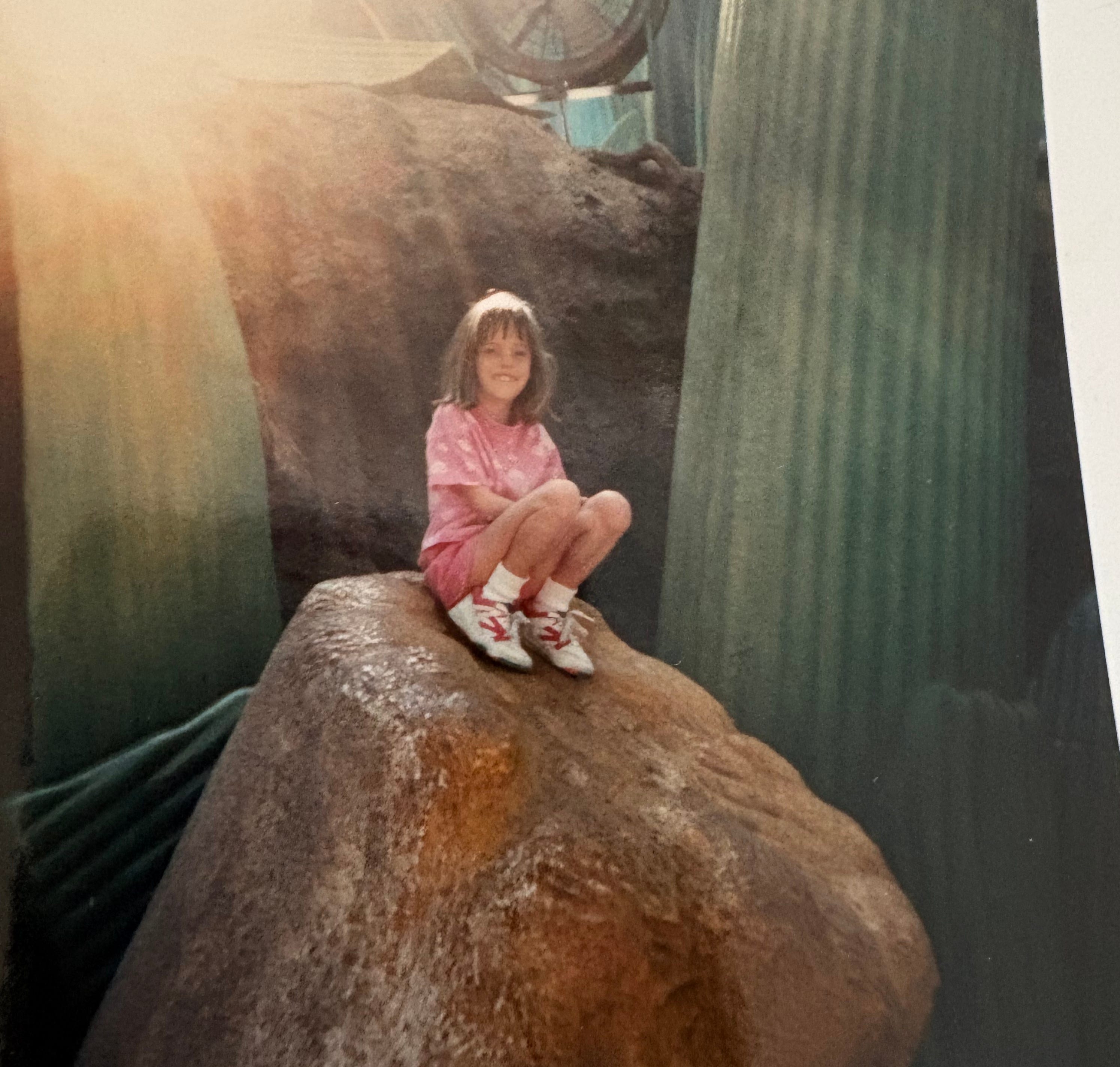
I want to sit that first grader down and tell her that it’s not her responsibility to allay the fears of her classmates. I want to tell her that when she gets older there will be so many smart writers and activists educating on diversity and body difference that the responsibility won’t all fall on her. I want to tell her that she doesn’t have to change the world while she’s on the playground. I want to tell her that it’s okay to just be a kid. I want to tell her that her own humanity and worth don’t have to hinge on her ability to answer these questions in a way that others can understand and learn from.
I want to see her shoulders lighten. I want to see her walk more confidently. I want to see her boundaries grow, her energy protected. I wonder what she would say
In Case You Missed It
Check out my 2025 year in review:
You are reading the intangibles, by writer and creative writing instructor Allison Kirkland. This publication is geared toward writers of memoir and creative nonfiction and the people who love them.
All writers should be paid for their work. But if a paid subscription doesn't make sense for you right now, there are other ways to support the growth of this reader-supported publication:
click that little heart to "like" the post
gift a subscription to a creative friend
share this essay with another writer
leave a comment and help grow this creative community
Thanks for reading. I’m so glad you’re here.
Oooh. Hand on my chest. With you every step of this essay. Especially moved by your message for your first grade self. The weight of needing to explain and teach and convince an audience of your equal humanity is so great. It's heartbreaking how many of us were taught that it was our most important job. I feel my little self moving toward your little self in wordless solidarity💛
This was such a beautiful read and so timely for me as I just went through a relatively jarring intrusive question experience a couple of days ago. You've articulated so much of what exists under these exchanges.